
The workplace is evolving more quickly than ever. What was once science fiction—robots carrying out jobs, artificial intelligence (AI) controlling workflows, and workers cooperating from different parts of the world—is now commonplace.
Our methods of working, communicating, and producing value are being redesigned by AI-powered assistants and hybrid workplaces that combine home and office life. This change isn’t only about technology, though; it’s also about people, purpose, and how we adjust to a whole new way of working.
Examining the ways in which automation, AI, and hybrid work models are changing the global workforce and its implications for the future is important.
🌍 A World Under Transition
More change has occurred in the global workforce in recent years than in the preceding several decades put together. Companies were forced to embrace automation, cloud collaboration, and remote work at a never-before-seen rate as a result of the pandemic’s acceleration of digital transformation.
As 2025 draws nearer, the issue is no longer, “Will the workplace change?” – “How quickly can we keep up?”
AI and automation are hardly far-fetched ideas anymore. They are incorporated into practically every sector, including education, entertainment, logistics, and healthcare. However, instead of completely replacing people, they are changing what people are best at.
⚙️ Automation: Transitioning from Standard to Innovative

Workplace automation has existed for many years; consider automated emails, software bots, and manufacturing lines. However, the most recent wave is distinct.
Machines can now analyse data, forecast outcomes, and even learn from their errors thanks to the development of intelligent automation. Robots assist humans in manufacturing. Repetitive duties like data input and reporting are handled by RPA (Robotic Process Automation) in workplaces, freeing up staff members to concentrate on strategic and creative work.
As an illustration:
Finance: Fraud detection and transaction processing are done by automated systems.
Healthcare: AI improves the accuracy of disease diagnosis.
Customer service: Basic problems are now resolved in seconds via chatbots.
Instead than eliminating people from the workforce, automation is encouraging us to pursue higher-value jobs that call for creativity, empathy, and sound judgement.
🧠 Artificial Intelligence: The Upcoming Co-worker
Not only is artificial intelligence altering our methods of working, but it is also influencing who we collaborate with.
We now use AI tools in many aspects of our daily job, from predictive algorithms that predict business trends to writing assistants that assist us in creating emails. AI aids in the creation of designs, video editing, and even music composition in the creative industries.
Collaboration is the primary change. AI has evolved from a tool to a collaborator. The most significant assets in the workplace are workers who learn to work alongside AI, not against it.
But with this new collaboration comes accountability. Data protection, prejudice reduction, and the ethical application of AI are becoming important topics of conversation. The future of AI in the workplace will rely on how humans direct and control machines in addition to their capabilities.
🏢 The Growth of Hybrid Work: Combining the Best Features of Both
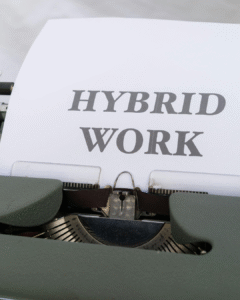
Many businesses have come to the crucial realisation that workers don’t want to resume the traditional 9–5 office schedule after years of remote work. They miss the structure, creativity, and connections of office life, but they also desire freedom.
This is when hybrid work is useful. The freedom of remote work and the teamwork of in-person teams are combined to provide the best of both worlds.
Within workplaces that are hybrid:
Workers can work in the office, from home, or in a café, depending on their preferred workspace.
Offices are no longer cubicle farms but rather collaborative spaces.
It is easy to operate remotely because to digital platforms like Zoom, Slack, Notion, and Microsoft Teams.
🌐 International Impact: Work Without Boundaries
Geographical boundaries have been eliminated by remote and hybrid work paradigms. Workers no longer need to go to large cities in search of opportunity, and companies are now able to hire talent from anywhere in the world.
With this global workforce strategy, we are producing:
Teams comprising individuals from various time zones and cultures will increase variety.
Additional opportunity: Competent workers from emerging nations joining international markets.
Increased competition: Businesses can recruit top individuals from around the world, which raises the standard for performance and skill.
Cultural communication, digital fatigue, and the requirement for robust cybersecurity and data policies are some of the new difficulties it brings.
💡 The Skills of the Future
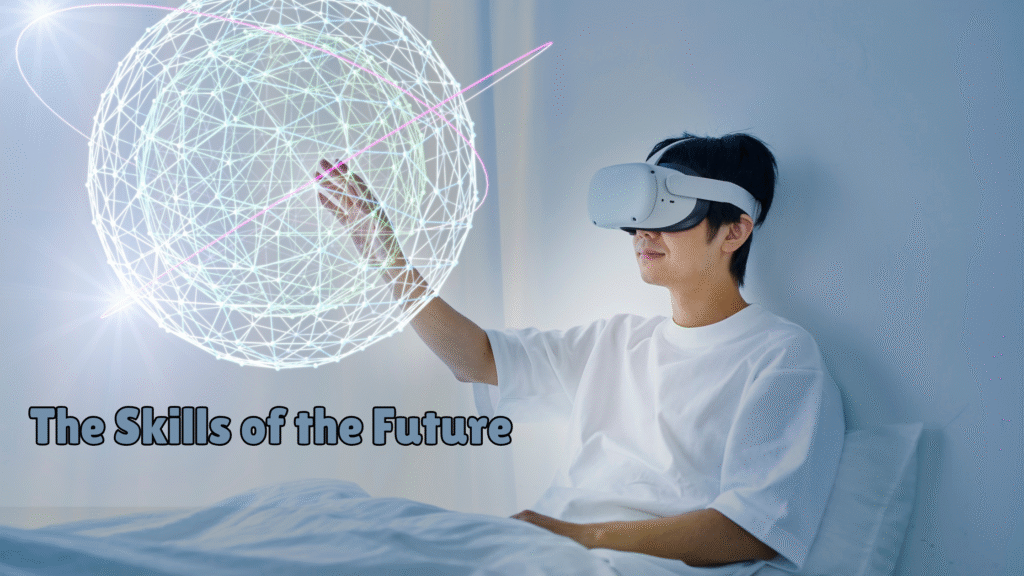
As automation and AI handle more technical or repetitive work, the skills that make humans unique are becoming more valuable than ever.
Top skills for the future include:
- Critical thinking & problem-solving
- Emotional intelligence & empathy
- Creativity & adaptability
- Digital literacy & AI collaboration
- Global communication & teamwork
Learning how to “co-create” with technology will be one of the defining abilities of tomorrow’s professionals.
Instead of arriving, the future of work is already here. AI and automation are transforming our operations, and hybrid work is altering the environments in which we work. They are working together to create a world that is more innovative, inclusive, and adaptable than it has ever been.
However, the fundamental query still stands: how will we adjust?
If we prioritise education, teamwork, and humanity, the future won’t be something to be feared but rather something to be built. In addition to being places, offices of the future will be creative ecosystems driven by both intelligent machines and human minds.