
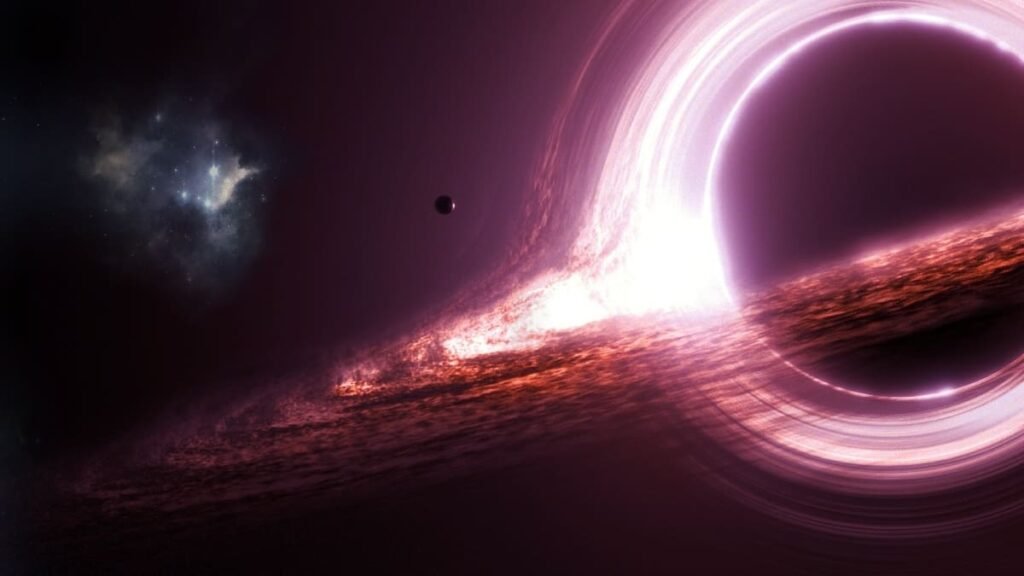
One of the universe’s most enigmatic objects is a black hole. They are incredibly strong, invisible and able to bend both space and time. However, what if a person truly fell into one?
For many years, NASA researchers have used telescopes, physics, and mathematical models to study black holes. Fortunately, no one has ever fallen into a black hole, but science provides us with a shockingly accurate picture of what would happen.
Step by step, let’s start on that terrible adventure.
First, let’s define a black hole.
A black hole is an area of space where gravity is so intense that nothing, not even light, can escape.
It is created when a huge star explodes as a supernova and then collapses due to its own gravity. A gravitational hole in space is created when the core gets so thick.
The singularity, or point of infinite density, is at the center.
The event horizon, or point of no return, is located around it.
You can never return once you’ve crossed the event horizon.
Time Would Slow Down as You Got Closer to the Black Hole

As you approach:
. Gravity increases.
. In comparison to the outside world, time slows down for you.
. You would seem to be moving more slowly to an outside observer, nearly freezing at the black hole’s border.
However, you wouldn’t experience time slowing down; initially, everything would seem normal to you.
The Point of No Return: Crossing the Event Horizon
When the event horizon is crossed:
. It becomes physically impossible to flee.
. You would see the universe twist and fade behind you because light cannot escape.
. Time and space switch places; going forward in time becomes just as natural as going downhill.
Physics as we know it starts to break at this point.
You Would Be Stretched Like Noodles If You Were Spaghettified
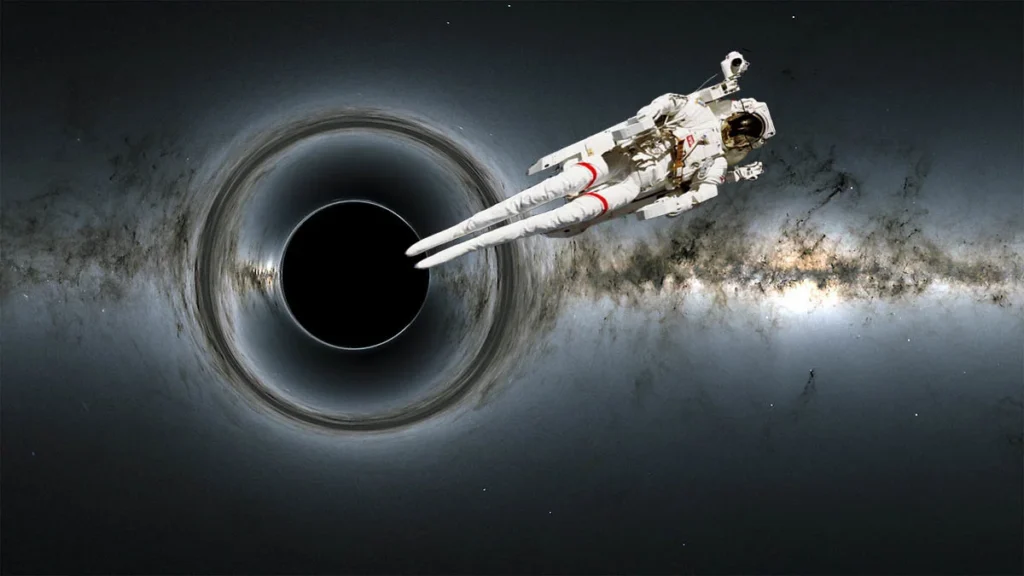
Spaghettification is one of the most bizarre results.
Due to the fact that gravity is far stronger at your feet than at your head:
. It would cause your body to extend vertically.
. You would be compressed horizontally at the same moment.
. Like a piece of spaghetti, you would grow thinner and longer.
Your atoms would finally be ripped apart by this straining.
Before you even get to the middle, this occurs.
Everything Breaks Near the Singularity
As you descend further:
. The temperature rises dramatically.
. The strength of tidal forces becomes unlimited.
. The normal form of matter is not possible.
Your particles, atoms, and bodies would all be destroyed and reduced to energy.
You wouldn’t make it through this phase.
Thus… Would You Experience Pain?

Surprisingly, if the black hole is supermassive, you might not feel anything for the most of the fall.
Spaghettification would swiftly kill you in tiny black holes.
You might pass through the event horizon of a larger black hole without realizing it, only to be destroyed afterwards.
It is difficult to survive either way.
What Takes Place with Your Data?
One of the greatest puzzles in physics is this.
According to several theories:
. Your data is permanently lost.
Others say:
. On the event horizon, it is kept.
. or it eventually escapes as radiation (Hawking radiation).
This is an open subject of modern physics, and NASA experts are continuously researching it.
Concluding Remark
It would not be the same as falling into a hole in the ground to fall into a black hole.
It would fall into:
. A location where time stands still
. Space collapses
. Matter cannot endure.
. And there are limits to the rules of physics.
Black holes serve as a reminder of the universe’s true strangeness, might, and beauty.
They are windows into the most profound rules of reality, not monsters.